Bali as a “Green Island.” How?


The Mandara toll road in Bali, only 10.5 kilometers long, is often called the most beautiful toll road in Indonesia, and even the world. Bali has become a powerful magical spell. It’s no wonder tens of millions of people are “enchanted” to visit Bali every year.
Data shows that the total number of tourists visiting Bali in 2024 is projected to reach 16.4 million, a 7.9% increase from 15.2 million in 2023. This includes 10.1 million domestic tourists and 6.33 million foreign tourists. This number exceeds Bali’s population of approximately 4.5 million.
One way to maintain Bali’s tourism reputation has been through its designation as a green island since 2018. Bali is naturally green. However, if not mitigated, this slogan will remain in name only. Bali is already experiencing the phenomenon of overtourism.
According to the 2024 Environmental Quality Index (IKLH) survey, Bali is not included in the category of provinces/islands with the top 10 IKLH. The top ten Indonesian cities with the best IKLH are: Tidore Islands (80.26), Sungai Penuh (79.48), Sorong (79.09), Sabang (77.95), Padang (77.26), Baubau (77.2), Jayapura (75.5), Batu (74.43), Subulussalam (74.28), and Kendari (73.45).
Power plants
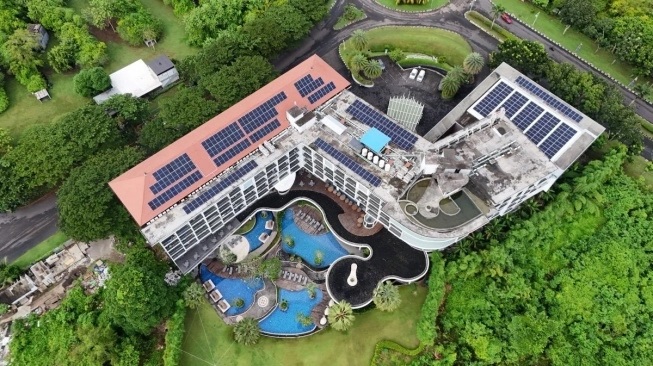
Bali’s power generation is almost 100% fossil-fueled. Currently, there are eight power plants on the island. Of these, only two are based on renewable energy: the Kayubihi solar power plant (PLTS) and the Muara Panji micro-hydro power plant (PLTMH).
On the other hand, Bali’s electricity system remains heavily dependent on the Java electricity system. In 2018-2019, Bali utilized 5.49 megawatts of renewable energy, representing only 0.59% of total energy consumption. The target for renewable energy use by 2025 is 11% of total electricity consumption.
Bali is truly rich in new and renewable energy resources. The Center for Community-Based Renewable Energy (CORE) at Udayana University, in collaboration with Greenpeace Indonesia, found Bali’s highest solar energy potential, accounting for approximately 98% of the total renewable energy potential in the country.
The solar energy potential in Bali’s district/city centers ranges from 4.01 to 6.13 kWh/m²/day, with an average of 4.89 kWh/m²/day. Bali’s solar irradiance ranges from 1,490 to 1,776 kWh/m²/year, exceeding the European standard for solar energy project feasibility of 900 kWh/m²/year.
The use of clean energy in Bali is in line with Bali Governor Regulation Number 45 of 2019 concerning Bali Clean Energy, which aims to improve the quality of renewable energy potential, providing energy for communities who do not yet have access to energy, both at the household, transportation, tourism, and even agricultural levels.
If Bali Province continues to use fossil fuels (PLTU), carbon emissions (CO2) on the island will escalate. For example, the Celukan Bawang PLTU burns 5,200 tons of coal daily.
Private vehicle
The number of motorized vehicles on the island of Bali, according to 2024 BPS data, reached 5,278,984 units, the majority of which were motorcycles (4,526,734 units), private four-wheeled vehicles (544,640 units), trucks (188,199 units), buses (15,981 units), and passenger cars (544,640 units).
The high use of private motorized vehicles results in significant exhaust emissions. Moreover, the majority of these vehicles do not yet use Euro-standard fuel, which is more environmentally friendly. On the other hand, the rise in electric vehicle use in Bali is encouraging. According to the Regional Revenue Agency, by September 2024, the number of electric vehicles had doubled, reaching 8,019; consisting of 6,870 four-wheeled electric vehicles and 1,092 two-wheeled electric vehicles.
According to data from PT PLN Bali, the number of charging stations (SPKLU) in Bali has increased by 285 percent. According to an analysis by WRI (World Resources Institute) Indonesia, a significant increase in the number of electric vehicles in Bali could contribute to a 43 percent reduction in carbon emissions.
Besides encouraging the growth and use of electric vehicles, an equally urgent priority is the implementation of mass public transportation. As a world-class tourist island, Bali lacks mass public transportation. There were plans to build mass transit systems like the LRT (Light Rail Transit) and even the MRT (Mass Rapid Transit), but these plans have stalled.
Besides the lack of serious support, Bali also faces challenges related to customs and culture. Meanwhile, foreign tourists are increasingly adopting motorcycles. However, on social media, we often see tourists disregarding traffic regulations or even maintaining proper driving documents.
The phenomenon of cigarettes
According to the Center for NCDs, Tobacco Control, and Lung Health at Udayana University in Bali, based on the 2023 National Health Survey, smoking prevalence on the island of Bali remains high. Data shows that 16% of Bali’s population aged 10 and over are smokers, with an average daily consumption of 12 cigarettes and an average price of Rp 21,800 per pack.
Even more alarming, 56% of smokers in Bali started smoking at a young age, between the ages of 10 and 19. The prevalence of e-cigarette use in Bali is 8.5%, placing Bali second nationally after Yogyakarta.
This trend requires serious attention. It results in high emissions, not just from smoke but also from cigarette packaging and butts. This is especially true if people smoke indiscriminately, discarding packaging and butts wherever they please, resulting in even greater waste generation.
Moreover, cigarette butts are hazardous and toxic waste (B3), and they end up in rivers, beaches, and the ocean. Efforts to control cigarette consumption in Bali are needed, one way being to establish smoke-free tourism, as in many tourist destinations around the world.
Waste management
Another crucial issue that cannot be ignored is waste management. The tourism sector contributes the most to waste generation, both organic and inorganic. Data from the National Waste Management Information System (SIPSN) indicates that waste accumulation in Bali Province will reach 1.2 million tons by 2024.
Denpasar City is the largest contributor, with approximately 360,000 tons of waste, with organic waste from food scraps and tree branches dominating the city, accounting for 68.32 percent. According to the Institute for Essential Services Reform (IESR), Bali’s waste volume increased by 30 percent between 2000 and 2024, due to a lack of public awareness of waste management and a surge in tourism to Bali.
Mitigation, Transformation
If Bali is serious about realizing its green island vision, these issues must be immediately mitigated and transformed, specifically by transforming the use of renewable energy, particularly for power generation. Meanwhile, for the transportation sector, there’s no other option than installing mass rapid transit systems, such as the LRT, monorail, or even the MRT.
Also, restrictions on private vehicle use on certain roads, such as implementing Electronic Road Pricing (ERP) and progressive parking rates, should be implemented. Bali must avoid becoming a new target for traffic jams.
Meanwhile, when it comes to waste management, there’s no single solution that can solve the waste problem in Bali, or even in Indonesia. It requires an integrated and comprehensive approach, involving all parties, from the community, government, and industry.
Furthermore, it’s also necessary to instill a circular economy mindset and responsible waste management in the community, who understand that waste processing in Indonesia is very expensive, reaching US$100 per ton. Therefore, waste reduction at the upstream (primary source) is the most affordable option.
To realize a green Bali, the ultimate goal is to reduce carbon emissions in Bali. According to data from the Bali Provincial Development Planning Agency (Bappeda), greenhouse gas production in Bali is alarming. According to the 2022 Greenhouse Gas Inventory Organizer (IGRK) report, Bali’s greenhouse gas emissions reached 12,089.85 billion grams of CO2 equivalent. The energy sector was the largest contributor, with 8,205.87 billion grams of CO2 equivalent (67.87%), followed by the waste sector with 3,872.41 billion grams of CO2 equivalent (32.03%), and the agricultural sector with 1,171.68 billion grams of CO2 equivalent (9.68%).
However, according to an analysis by the World Resources Institute, greenhouse gas emissions from the transportation sector in Bali contribute 43% of total emissions. This figure is significantly higher than the national figure of 16%. The energy sector accounts for the highest number of emissions nationally, with 49% from power plants and industry.
Bali will become a “green island” if crucial issues are seriously mitigated. Let’s save Bali’s ecological aspects.
Source: https://www.forestdigest.com/detail/2766/bali-over-tourism-green-island



Responses